Choosing a Rooftop Wind Turbine in 2026 requires more than comparing advertised wattage. A turbine that looks powerful on a brochure may perform poorly above a noisy, turbulent roof. Paul Gipe, a respected wind-energy analyst, has warned, “Small wind turbines are not small versions of large wind turbines.” That distinction should guide every purchase decision.
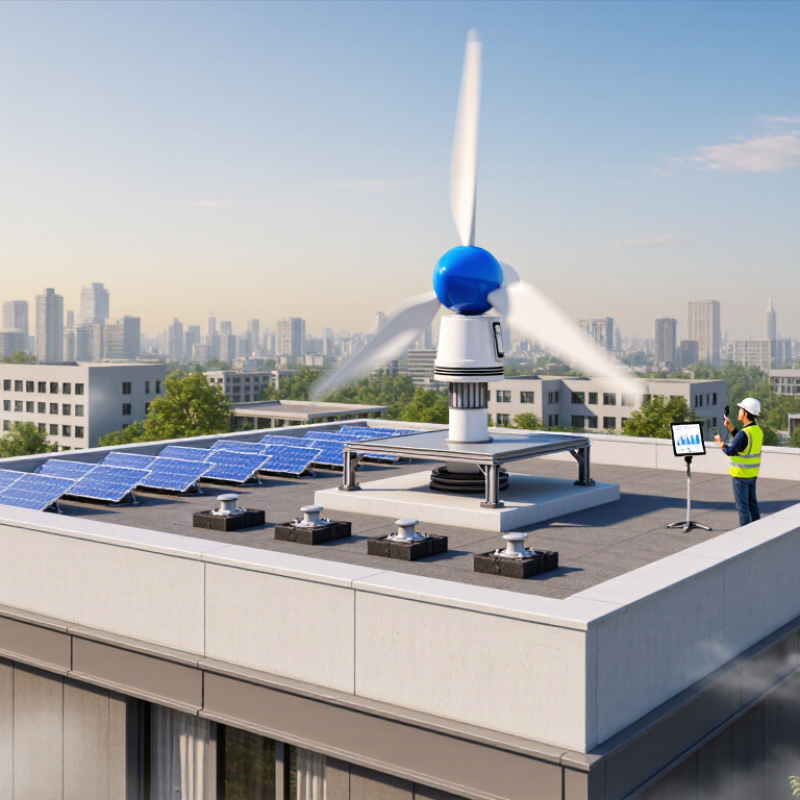
Begin with the building itself. Measure roof height, nearby trees, parapets, towers, and seasonal wind direction. A rooftop turbine needs clean airflow, but many urban roofs provide swirling gusts instead. Ask for a site-specific wind assessment, not only a regional wind map. The difference can be dramatic. A handheld anemometer, mounted correctly for several months, may reveal uncomfortable truths.
Review swept area, cut-in speed, rated power, sound levels, vibration control, and expected annual energy production. Do not trust peak output alone. Request independent testing, warranty terms, maintenance intervals, and evidence related to IEC 61400-2 where applicable. A structural engineer should confirm that the roof, anchors, and vibration isolation system can handle repeated loads. Local planning, electrical, fire, and building requirements also deserve early attention.
The best Rooftop Wind Turbine may be smaller than expected. It might also be the wrong technology for a sheltered city building. Solar panels, batteries, or a ground-mounted system could deliver more reliable energy. That is not a failure. It is useful evidence. This guide examines practical selection criteria for 2026, including performance, safety, noise, installation complexity, lifecycle cost, and honest return-on-investment expectations.
Choosing a rooftop wind turbine in 2026 starts with demand, not excitement. Estimate your monthly electricity use from twelve utility bills. Then identify daytime loads, such as ventilation, pumps, or refrigeration. A small office may need steady power, while a remote sensor needs very little. Match the turbine to that profile. Oversizing wastes money.
Budget for more than the turbine. Include a structural survey, mounting frame, inverter, wiring, controls, permits, and maintenance access. An engineer should verify roof loading, vibration paths, and attachment points. I have seen attractive estimates fail after installers ignored difficult cable routes. Allow a repair reserve. Roof work is rarely simple.
Noise and turbulence can decide the project. Measure sound near bedrooms, offices, and neighboring properties, especially during gusts. Rooftop edges often create unstable airflow, reducing performance and increasing vibration. Use a professional wind assessment instead of relying on regional averages. A realistic target may be only 5–15% annual capacity factor. That means the turbine produces its rated output for 5–15% of the year, averaged over time. Results remain uncertain. Nearby buildings, seasonal winds, and roof height can change the forecast. Compare projected energy with your electricity demand and total ownership cost. If the numbers feel marginal, pause and investigate them again.
How to Choose a Rooftop Wind Turbine in 2026?
Audit the roof before comparing turbine specifications. Record wind speed and direction for 12 months, ideally at the planned hub height. Short measurements can mislead. Winter storms may inflate the average, while calm summer weeks expose weak production.
The U.S. Department of Energy’s Distributed Wind Market Report stresses site-specific assessment for small wind projects. The Global Wind Atlas uses high-resolution modeling, but its maps cannot replace rooftop measurements. Buildings create turbulence, especially near parapets, HVAC units, antennas, and neighboring towers. IEC 61400-2 also requires small turbines to address turbulence, loads, and structural safety. A 2.5–4 m/s cut-in speed sounds attractive, yet cut-in is not rated output. At 3 m/s, available wind power is only about 42% of the power at 4 m/s, because power changes with the cube of speed. That difference hurts.
Tips: Mount the anemometer above the roof’s disturbed airflow. Log gusts, turbulence intensity, and prevailing direction, not just monthly averages. Compare your readings with long-term reference data from the Global Wind Atlas or a certified weather station. Then ask an engineer to check vibration transfer, roof loading, and maintenance access.
Be skeptical of glossy payback charts. I have seen calm rooftops look promising on paper. They were not. A twelve-month record is useful, but imperfect; nearby buildings can still make the final estimate uncertain.
Choosing a rooftop wind turbine in 2026 starts with certification, not advertising. IEC 61400-2 covers small wind turbines with rotor-swept areas below 200 m². Ask for the certificate, test scope, design wind speed, noise results, and structural loads. A smaller rotor may reduce roof loading, but it can also produce less energy during weak winds.
Study the power curve carefully. It should show output across wind speeds, ideally using independent testing under IEC 61400-12-1 measurement methods. Compare annual energy estimates at your site’s measured wind distribution, not at a smooth laboratory wind speed.
The U.S. Department of Energy’s 2023 Distributed Wind Market Report recorded about 1,145 MW of distributed wind capacity installed in the United States through 2023. That figure includes many non-rooftop systems, so it cannot prove rooftop performance.
I still treat rooftop turbulence as the weak link. Nearby parapets, ducts, and taller buildings can distort airflow within seconds.
Tips: Request a site-specific wind assessment with turbulence intensity, not only average wind speed. Check whether the certificate matches the exact rotor and tower configuration. Leave maintenance access around the machine. Also question optimistic energy claims.
A power curve can be technically correct, yet the roof may never provide the required clean airflow. That uncomfortable gap deserves more attention.
How to Choose a Rooftop Wind Turbine in 2026? Start with the building, not the turbine. The U.S. Department of Energy’s 2023 Distributed Wind Market Report recorded about 1,145 MW across 89,000 turbines through 2022. Most were not rooftop machines. Rooftops create turbulence, uneven airflow, and concentrated structural loads.
Ask a structural engineer to check dead load, thrust, overturning moment, and fatigue. Use site-specific wind data, not a nearby airport average. ASCE 7-22 requires wind design to consider exposure, height, directionality, and local pressure effects. A concrete roof may carry static weight but still fail under repeated vibration. That distinction matters.
Vibration needs field attention. Measure natural frequencies and keep them away from rotor and blade-pass frequencies. Inspect parapets, fasteners, welds, and waterproofing after commissioning. Setbacks should protect roof edges, occupants, neighboring properties, and maintenance access; local planning rules still control. IEC 61400-2 provides small-wind design requirements, including fatigue assessment and a typical 20-year design-life framework. I would request calculations for that full period, not only a first-year energy estimate.
The Global Wind Report 2024 recorded 117 GW of new wind capacity worldwide in 2023, but that total mainly represents utility-scale projects. Rooftop performance can be far less predictable. One overlooked issue is noise. Another is access. A failed assumption here can become an expensive repair.
| Validation Dimension | Data or Engineering Benchmark | What to Verify Before Selection | Evidence Required | Priority |
|---|---|---|---|---|
| Applicable design standard | Use the wind-loading standard adopted at the project location, such as ASCE 7-22 in the United States or the applicable Eurocode and national annex in Europe. Small wind turbines should also be assessed against IEC 61400-2 where applicable. | Confirm the governing building code, wind region, exposure category, importance category, seismic requirements, and local permitting rules. | Code compliance statement, design basis, and calculations signed by a qualified structural engineer. | Required |
| Turbine class and operating wind range | Compare the turbine’s certified design wind conditions with the site’s measured or professionally modeled wind climate. Rooftop locations usually experience higher turbulence than open terrain. | Check annual mean wind speed at hub height, extreme wind speed, turbulence intensity, cut-in speed, rated speed, cut-out speed, and survival or parked wind speed. | Site-specific wind assessment, turbine technical datasheet, and certification documentation. | Required |
| Rotor diameter and swept area | Swept area is calculated as A = πD²/4. Doubling rotor diameter increases swept area, and therefore potential aerodynamic loading, by approximately four times at the same wind speed. | Use the actual rotor diameter, projected area, tower height, support geometry, and extreme-wind coefficients in the structural model. | General arrangement drawing, rotor dimensions, aerodynamic coefficients, and load cases. | Required |
| Vertical and horizontal structural loads | Assess dead load, thrust, torque, overturning moment, drag, uplift, braking loads, maintenance loads, and accidental or emergency-stop conditions. Wind pressure varies approximately with the square of wind speed. | Check both serviceability and ultimate limit states at roof beams, columns, slabs, parapets, anchors, frames, and foundations. | Manufacturer load envelope plus project-specific reactions for normal, extreme, parked, braking, and fault conditions. | Required |
| Roof reserve capacity | The available reserve must cover the turbine, support frame, ballast, cabling, access equipment, maintenance loads, snow or rain loads, and wind-induced reactions. | Do not evaluate only the turbine mass. Confirm load paths to primary structural members and check local punching, bearing, shear, bending, and connection capacity. | As-built drawings, structural survey, material information, reinforcement records where available, and engineer’s capacity check. | Required |
| Support frame and anchorage | Support systems may be mechanically anchored, clamped, or ballasted. Ballast reduces roof penetration but adds permanent gravity load and may increase seismic or sliding demands. | Verify anchor tension, shear, pull-out, edge distance, corrosion protection, waterproofing details, sliding resistance, and load transfer into the roof structure. | Connection calculations, anchor test data where required, ballast calculations, and waterproofing method statement. | Required |
| Dynamic behavior and natural frequency | Wind turbines apply cyclic loads at rotational frequency and blade-passing frequency. The support and building should not be tuned close to dominant excitation frequencies. | Perform a modal analysis. As a preliminary engineering screen, maintain meaningful frequency separation rather than relying on static calculations alone; the final separation criterion must be set by the engineer. | Finite-element modal analysis, measured vibration data where appropriate, and confirmation of operating-speed margins. | Required |
| Vibration and resonance | Vibration can result from rotor imbalance, blade pitch variation, tower flexibility, bearing defects, turbulence, or misalignment. Rooftop transmission can affect occupants and building finishes even when structural strength is adequate. | Specify vibration limits for the building and occupied spaces. Include isolation mounts only when their stiffness, damping, movement, fatigue, and fire performance are engineered. | Baseline vibration survey, operating vibration measurements, balancing records, isolation details, and commissioning limits. | Required |
| Roof-edge and parapet setback | There is no single universal setback that replaces local code or project-specific aerodynamic analysis. Roof edges and parapets can create separated flow, turbulence, and increased fatigue loading. | Keep the rotor clear of roof edges, parapets, access routes, and adjacent equipment according to the engineer’s wind assessment and the turbine installation manual. Avoid placing the rotor in the immediate wake of tall obstructions. | Roof plan and section, obstruction survey, wind-flow assessment, maintenance clearance plan, and local authority requirements. | Required |
| Clearance from people and property | Provide controlled exclusion zones for falling objects, blade failure, ice throw where relevant, maintenance operations, and emergency access. | Check clearance to occupied areas, public walkways, neighboring property, HVAC intakes, exhaust outlets, antennas, lightning protection systems, and fire-safety access routes. | Risk assessment, site plan, fall-zone analysis, signage plan, and emergency shutdown procedure. | Required |
| Noise and occupant comfort | Noise is affected by tip speed, turbulence, blade condition, operating mode, roof reflections, and background sound. A single sound-power value does not predict indoor comfort by itself. | Check manufacturer sound-power data, octave-band information where available, tonal noise, night-time limits, and predicted levels at nearby receptors and occupied rooms. | Acoustic assessment, equipment sound data, background-noise survey, and post-installation verification measurements. | Recommended |
| Lightning, grounding, and electrical safety | A rooftop turbine is a high point and may alter the building’s lightning-risk profile. Electrical systems require suitable overcurrent protection, isolation, grounding, and surge protection. | Coordinate the turbine with the building lightning-protection system, bonding network, inverter, disconnects, cable routes, firestopping, and emergency shutdown controls. | Electrical single-line diagram, grounding and bonding design, surge-protection specification, inspection records, and permit documentation. | Required |
| Waterproofing and roof warranty | Penetrations, concentrated loads, ballast pads, vibration, and maintenance traffic can reduce roof-service performance if not detailed correctly. | Confirm compatibility with the existing membrane, drainage falls, roof age, warranty conditions, corrosion protection, and replacement access. | Roof-condition survey, approved penetration details, protection-layer specification, drainage review, and warranty approval. | Required |
| Fatigue and 20-year service life | A 20-year design-life target is commonly used for wind-energy equipment, but it must be supported by fatigue calculations, material selection, corrosion protection, and a maintenance plan. | Review cumulative fatigue damage for blades, hub, shaft, bearings, tower, frame, welds, bolts, anchors, and roof connections under the site’s turbulence and operating cycles. | Design-life statement, fatigue analysis, inspection intervals, replacement schedule, spare-parts strategy, and corrosion-protection plan. | 20-Year Target |
| Maintenance and component replacement | Routine inspections commonly include blades, fasteners, bearings, brakes, electrical equipment, corrosion, vibration, and roof interfaces. Actual intervals depend on the design and environment. | Confirm safe access, lifting capacity, crane or hoist requirements, isolation procedures, replacement routes, working-at-height controls, and downtime assumptions. | Operation and maintenance manual, access plan, lifting plan, inspection checklist, and maintenance-cost estimate. | Recommended |
| Energy-yield realism | Annual energy production depends on the site wind-speed distribution, turbulence, availability, air density, electrical losses, curtailment, and wake effects. Rated power alone is not a reliable production estimate. | Use a site-specific wind-speed frequency distribution and power curve. Include rooftop turbulence, downtime, seasonal variation, icing where relevant, and conservative uncertainty allowances. | Energy-yield model, wind-measurement or validated resource assessment, power curve, loss assumptions, and sensitivity analysis. | Recommended |
| Final go/no-go decision | Proceed only when structural, dynamic, aerodynamic, electrical, acoustic, fire, waterproofing, maintenance, and permitting requirements are all addressed. | Require written approval from the qualified structural engineer, electrical engineer, building owner, roof-warranty authority, and permitting authority as applicable. | Signed design package, permits, inspection plan, commissioning records, and documented acceptance criteria. | Required |
Start with annual kilowatt-hours, not the turbine’s rated power. The U.S. Department of Energy’s Distributed Wind Market Report stresses that site conditions strongly influence output. Rooftops often create turbulence, shielding, and vibration. A turbine rated at 5 kW will rarely produce 5 kW continuously. Use measured wind data, not a nearby airport average. IEC 61400-12-1 testing can support more credible power estimates.
Build three production cases. Estimate annual output, then reduce it by 10–30% for turbulence, downtime, electrical losses, and seasonal mismatch. That range is useful, but not universal. A 5,000 kWh estimate may become 3,500–4,500 kWh. Small errors matter. NREL guidance also highlights the importance of hub height and local wind-speed distribution. A six-month rooftop measurement may reveal an uncomfortable result: the site is simply too calm.
Compare avoided electricity costs with export tariffs. IRENA reported global weighted-average onshore wind LCOE near USD 0.033 per kWh in 2023, but rooftop projects usually face higher costs and weaker wind resources. A commercial tariff of USD 0.15 per kWh gives 4,000 self-consumed kWh an annual value of USD 600. If installed cost reaches USD 12,000, simple payback is 20 years, before maintenance and financing. Exported power may earn less. That changes the ranking quickly. Payback is useful, yet imperfect. Load timing, roof reinforcement, insurance, and replacement parts deserve their own line items.
Our Off-grid experts will come back with recommendations
Stay up to date with Leading Edge innovations and offers by joining our mailing list. Occassionally we send informative newsletters, offers and promotions that we think you'll find useful or interesting.